What You Need to Know Before Renovating Your Shower Enclosure
What You Need to Know Before Renovating Your Shower Enclosure
Shower enclosures – the place for a quick refresh – have developed rapidly. Today, their features can resemble those of a luxury spa. What if you could have a steam shower with coloured lighting and built-in speakers in your own bathroom?
It’s no surprise that water used for showering accounts for up to 17% of the average household water bill. This high consumption has led to the development of a new generation of showerheads designed to use less water more efficiently.
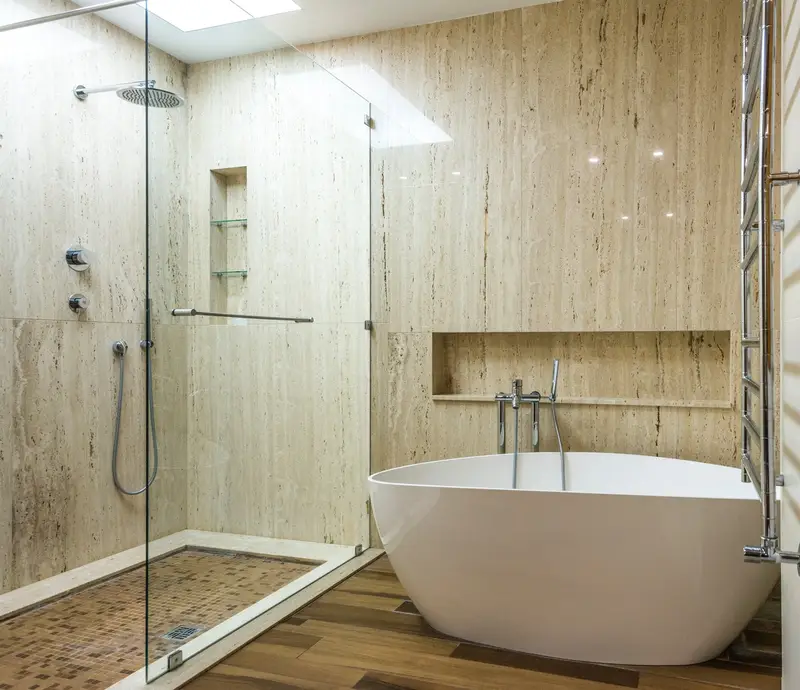
Thermostatic valves have eliminated temperature shocks, exposed plumbing has become a design feature, and frameless glass panels allow natural light to flood the shower space.
Add built-in niches for shampoos and shower gels, a hand shower, and a built-in bench – and suddenly you have a space where you’ll want to spend more time. For something truly luxurious, consider wall-mounted body jets, a steam shower, and underfloor heating. Before starting the renovation, consult a plumber, as correct pipe placement and connections are crucial for the system to function properly.
Let’s look at what you should know and consider before renovating your shower enclosure.
How Large Should Your Shower Enclosure Be?
One of the most accessible and space-efficient solutions is to use the niche where the bath previously stood – typically around 1 × 1.5 metres. Even a space of 1 m² can be ideal. The shower enclosure doesn’t need to be wider than one metre.
If you want a shower large enough for two people, you’ll need at least 1.5 metres in length to place showerheads at either end.
Where possible, place the control panel closer to the exit, so you can turn on the water without getting wet. It also looks much better aesthetically. Regardless of placement, make sure the controls are easily accessible even when you’re not standing directly in the shower.
Where to Position the Drain?
If you’re replacing your shower enclosure without changing its size or shape, you’ll save a lot of money by leaving the drain where it is. If the layout is standard, a prefabricated shower tray sloped towards the drain will also save time and money. These trays are made of solid polyurethane and attach directly to the tiles, giving a sleek finish.
If you want to move the drain, prepare for additional costs for demolition work.
Plan everything in advance. Review the plumbing layout with your contractor and ensure the shower valve and head are at a comfortable height.
Position convenient grab bars – useful even when washing just your feet. If you have enough space, install a bench.
If a steam shower is on your list, allow room for steam nozzles, wiring, and the steam generator, which should be placed outside the shower enclosure. Underfloor heating and modern smart controls may require additional space for wiring.
Two Ways to Improve Water Resistance in Your Shower
- Mortar Bed + Waterproofing
A custom-made copper channel filled with a thick mortar bed provides a stable base for tiles. First, however, apply two layers of a two-component liquid waterproof membrane, and prime the walls twice. The process takes around three days, but when done correctly, prevents water from leaking under the tiles. - Foam Installation Components
A simpler option is prefabricated foam components covered with a waterproof membrane. Using these, a 1 × 1 m shower can be completed in around six hours, after which tiling can begin.
Drains
It’s easier to tile around a square drain than a round one. Linear channel drains require a slight slope in one direction and are usually installed along the back wall. Precise tiling is crucial to ensure proper drainage and a flawless aesthetic.
Things to Consider
For the shower floor to be level with the rest of the bathroom, the frame under the shower tray must be lowered, or the floor outside raised. Ensure that the showerhead and all other jets are directed away from the door.
Shower Fixtures
While showerheads can be high-quality and reasonably priced, valves, controls, and surface finishes require a greater investment.
- Weight Matters
Valve bodies made from cast bronze or brass last longer and cause fewer problems. The same applies to other fixtures. Lacquered plastic is lighter and less durable than solid brass with a galvanised finish. Ceramic disc valves are also a good choice, as they resist debris in the plumbing. - Choose the Right Showerhead
Look for models with silicone nozzles that are easy to clean and provide even coverage. The best use flow control with pressure compensation – air infusion, spiral, or cross-pattern water flow – to mimic a strong rainfall.
Adjustable water flow intensity, from gentle mist to powerful stream, is a key advantage. Rain showers are designed to target the head first but do not use more water overall.
- Thermostatic Valve Provides Greater Control
A thermostatic valve is a bigger investment, but it provides safety and comfort that standard pressure valves cannot. It has two controls – one for volume and one for temperature – and keeps the water at the set temperature automatically.
Photo credit: Max Vakhtbovych – Pexels
Related articles

7 Things You Need to Know Before Renovating Your Flat or House
You know you want to renovate your flat or house, but you are not quite sure where to start. You are not alone. Many homeowners jump into a renovation project without fully understanding what lies ahead.

Restoring Original Parquet Floors: Why Refurbishing Old Flooring Is Worth It
Old wooden floors carry a unique character that is difficult to replicate in modern new builds. Restoring original parquet blocks is not only an environmentally responsible decision, but also an investment in the timeless beauty of your interior. A professionally refurbished wooden floor can often outperform brand new materials in both appearance and longevity.

Floor levelling: what it is and why you should never skip it
An uneven floor can be a hidden issue that gradually turns into a visible and expensive mistake. Properly levelling the surface before installing a floor covering is essential for both durability and appearance. Many people underestimate this step or skip it entirely, only to face problems later such as bubbles, warping or cracks. This is why floor levelling is a crucial stage in every renovation and new build. In this article, you will learn why a high-quality levelling base is so important and how it should be carried out correctly.