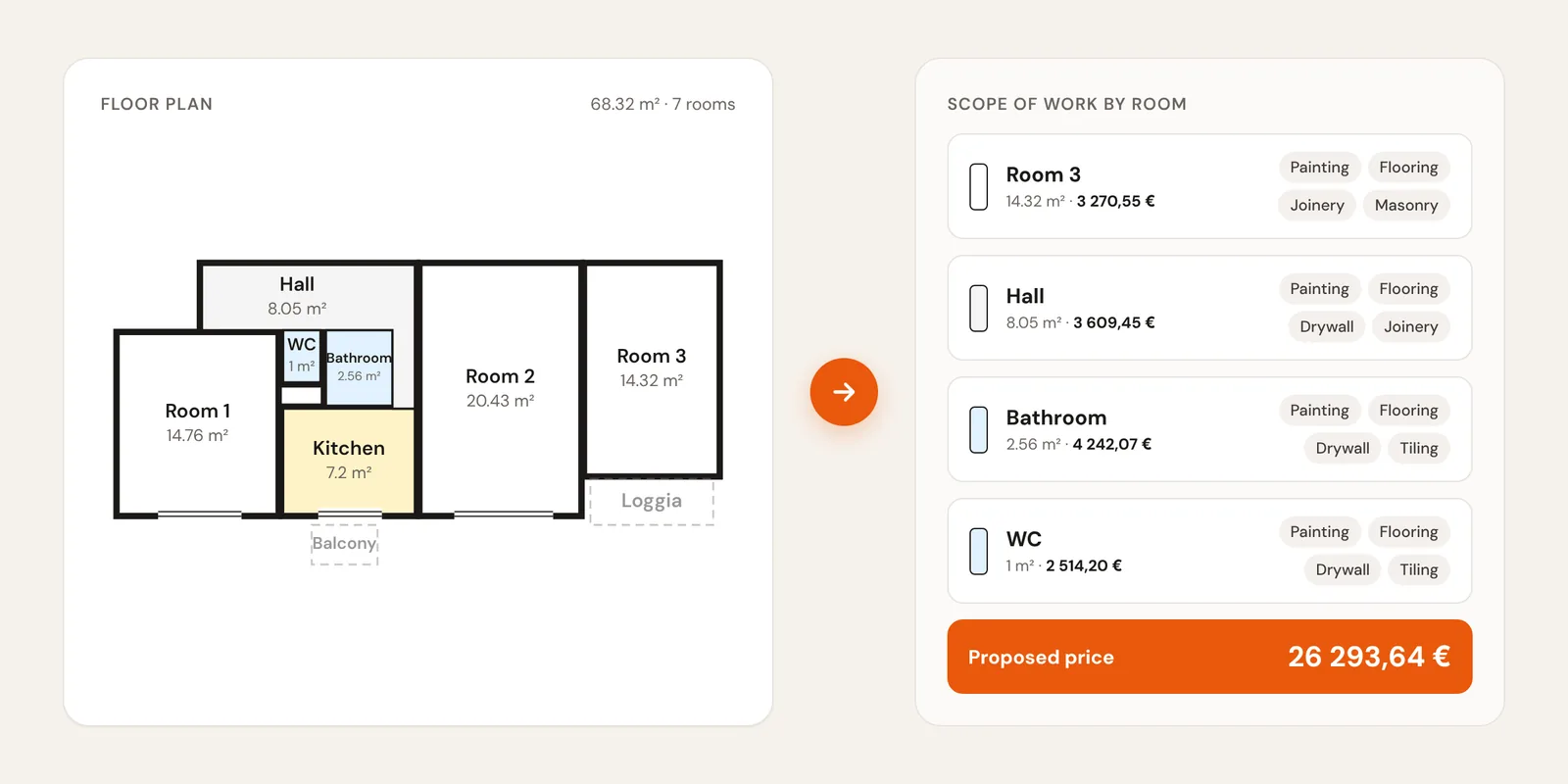
Upload a floor plan, plus a design and photos if you have them, and within minutes NUMIQ calculates a room-by-room budget for the whole flat. Introducing Estimate from a floor plan, the fastest way to price a flat or house renovation.
Replacing old electrical wiring is often the most delayed part of a renovation, yet outdated electrics are the leading technical cause of domestic fires. In 2026, a full rewire starts from €952 for a studio flat up to €3,824 for a 5-bedroom property, with chasing channels costing between €5.70 and €8.50 per linear metre and plastering repairs at €7.30 to €10.90 per linear metre. In this article, you will learn when a rewire is essential, the step-by-step process, real-world costs, and common mistakes to avoid.
LED lighting is now the standard for every renovation and new build, compared to traditional bulbs, it saves 80 to 90% in energy and lasts for 25,000 to 50,000 hours. In 2026, LED strip installation costs between €7.70 and €11.50 per linear metre, recessed spotlights with hole cutting cost €18.30 to €27.50 per unit, pendant chandeliers €41.90 to €62.90, and wall lights €13.40 to €20.20. In this article, you will find real-world installation prices for all types of light fittings, how to plan your lighting during a renovation, and which mistakes to avoid.
Electrical installation is one of the most critical and technically demanding tasks in both renovations and new builds. A full electrical installation and fit-out for a 1-bedroom flat in 2026 costs on average €952 to €1,428, for a 3-bedroom flat €1,435 to €2,153, and for a 5-bedroom property €2,603 to €3,824. In this overview, you will find real market prices based on property size, what the fit-out includes, the differences between flats and houses, and how to hire a qualified electrician with the correct certifications.
Underfloor heating has become standard in many new homes and high-quality renovations across Europe. This guide explains when to choose a wet system and when an electric one, what drives the cost, how installation runs from design to heating up the screed, which floor finish to choose and what to check at handover.
Drywall (plasterboard on a metal frame) is one of the most widely used systems in renovations and new builds across Europe. This article explains what the price of drywall work is made of, how single and double-layer partitions differ, what to know about ceilings, how drywall compares with masonry and which installation mistakes to avoid. Current prices per m² are on the Plasterboard work page.
In 2026, construction labour rates range from €3/m² for basic painting and decorating to over €80/m² for complete bathroom refurbishments. Compared to 2024, average prices have risen by 8 to 15%, driven primarily by material costs and energy inflation. This guide provides current market rates for the ten most common trades, pricing trends since 2020, regional variations, professional tips to save 10 to 20%, and a real-world flat renovation case study.
When it comes to drywall and plasterboard installations, quality isn't just about the metal studwork and boarding. The final result is defined by the finishing stages, professional jointing, internal corner caulking, crack prevention, and precision sanding. These details determine whether a partition wall or ceiling remains flawless years down the line. In this article, we explain the professional jointing process, why decorators' caulk is critical in high-stress areas, and what factors influence the longevity of drylining systems.
Drylining today is more than just a building material; it is a full-scale design tool. It allows for clean lines, hidden lighting, elegant pelmets at windows, and modern suspended ceilings with an architectural impact. In this article, we explain how the professional installation of atypical window endings for curtains or LED strips is carried out, what is involved in fitting design-focused plasterboard ceilings and soffits, and what factors influence the price list of construction works for more demanding solutions. If you want an interior to look sleek and timeless, these are the details that matter.
Drylining is now one of the most efficient solutions for interior fit-outs, ranging from new partition walls to suspended ceilings with integrated insulation. However, the quality of installation fundamentally impacts the acoustics, stability, and lifespan of the structure. In this professional guide, we explain the difference between single and double-skinned partitions, the installation process for plasterboard ceilings and bulkheads, the correct fitting of thermal and acoustic insulation, and the factors affecting construction labour rates. Whether you are planning a renovation or a new build, this article will help you make a technically sound decision.
Dry construction has become one of the most popular solutions for flat and house renovations across Europe in recent years. It is a building method that saves time, reduces mess on site, and offers a high level of flexibility when redesigning interior spaces. With dry construction, you can quickly install partition walls, suspended ceilings, or wall linings without relying on traditional wet processes such as bricklaying or concrete work.
In this article, you will learn what dry construction involves, its main advantages, and what to consider during installation.
Removing an old kitchen unit and other furniture is a common part of many home renovations. However, once the work is completed, a significant amount of waste remains and must be disposed of properly. Poor waste management can harm the environment and create complications during the next stages of the project.
If you are planning to remove your kitchen units, it is essential to know how to sort and dispose of waste responsibly. In this guide, we explain the available cleaning options and provide an overview of approximate costs so you can complete your renovation efficiently and sustainably.